Virtual Playground for Wi-Fi Hacking Without Buying Alfa Adapters
If you've ever tried studying wireless network security, you probably remember the classic ritual. First, you need to order the right USB adapter with an Atheros or Ralink chip supporting Monitor Mode and Packet Injection from a flea market. Then set up a couple of old routers at home, isolate them from your household devices, and hope that during deauthentication tests you don't accidentally interrupt your neighbors' phone calls on the landing.
Equipment breaks down, drivers fail on newer Linux kernels, and the learning process devolves into endless troubleshooting of USB passthrough to virtual machines.
The folks at Black Hills Information Security solved this problem radically. They created WifiForge—an open framework that spins up virtual access points, stations, and radio airwaves right within the operating system. No external antennas or wires needed.
What's Under the Hood
The project is built on Mininet-WiFi—an extension of the popular Mininet network emulator. Instead of real radio waves, the system uses the Linux kernel module mac80211_hwsim. This driver creates software wireless interfaces that behave exactly like physical Wi-Fi cards.
The operating system thinks dozens of wireless adapters are connected to it. You can switch these virtual interfaces into monitor mode, listen to traffic via Wireshark, send deauthentication frames, and capture WPA handshakes.
On top of this emulation, the developers from Black Hills wrote a Python wrapper. It automatically creates ready-made network topologies, configures virtual access points, and simulates client behavior.
What the Virtual Playground Can Do
Most training setups require manual configuration hostapd, creating configs, and launching a dozen terminals. Here, launching the lab environment is automated.
Emulating Common Attacks
WifiForge prepares the environment for most standard penetration testing scenarios:
- Intercepting 4-way handshake followed by offline password cracking.
- Attacks on WPA Enterprise protocol and credential harvesting via a fake RADIUS server.
- Deploying Rogue AP and Evil Twin with fake authorization pages through integration with Wifiphisher.
- Testing client resilience to deauthentication attacks.
Since all traffic is isolated in network namespaces, tests don't escape the virtual machine. You can safely run scripts on your work laptop in the office or a café without breaking the law or causing radio interference.
Working with the Standard Arsenal of Utilities
You won't need to learn specific syntax or work through proprietary wrappers. Inside the created namespaces, standard utilities from the Kali Linux arsenal are available:
- Aircrack-ng suite (airodump-ng, aireplay-ng, airmon-ng)
- Airgeddon
- Wifiphisher
- Arpspoof
- Hashcat and John the Ripper
The utilities interact with virtual interfaces exactly as they do with real physical Alfa Network cards.
How to Deploy and Try
The developers honestly warn in the repository: the project is actively evolving, so no one guarantees stability. You should run WifiForge strictly inside a separate virtual machine (for example, in VirtualBox or VMware), so that virtual network driver failures don't break the network on the host.
Installing the base environment on Ubuntu or Kali looks like this:
# Клонируем репозиторий проекта
git clone https://github.com/blackhillsinfosec/WifiForge.git
cd WifiForge

# Запускаем скрипт установки зависимостей
# Он подтянет mininet-wifi, системные пакеты и настроит модули ядра
sudo ./install.sh
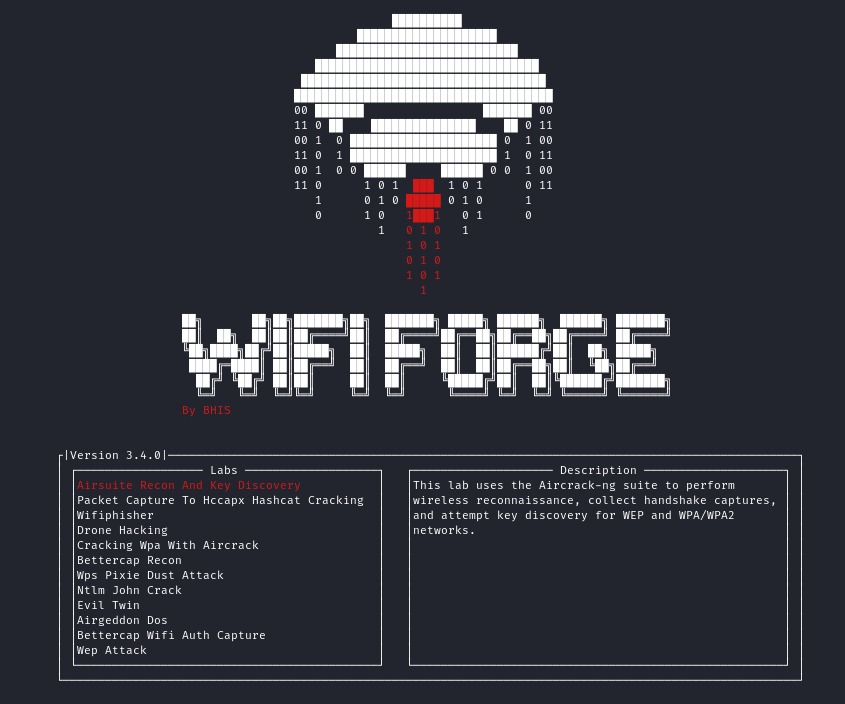
After installation, you get a console interface where you can select a specific lab scenario. The script will automatically spin up the target access point with the required encryption type, launch a background client that periodically reconnects to the network, and provide you with the attacker's virtual interface.
Where It Will Be Useful in Practice
The first obvious scenario is training beginners and preparing for certifications like OSWP. Instead of assembling a hardware lab, a student spins up a virtual environment in a couple of minutes.
The second scenario is running workshops and CTF competitions. Competition organizers know what chaos erupts in the air when twenty people simultaneously launch deauth attacks on one access point in the room. WifiForge gives each participant a personal isolated airwave.
The third use case is testing your own defensive scripts and attack detection systems (WIDS). If you're writing a wireless traffic monitor, running synthetic tests through mac80211_hwsim is much faster and more convenient than configuring a hardware packet generator.
Is It Worth Trying
If you're interested in network security but don't want to spend money on specialized adapters and mess around with routers, the project definitely deserves a spot in your bookmarks.
The project's documentation is still modest, part of the instructions are on a separate project site, but the source code of the scripts is written clearly. It's easy to figure out from it how topologies are constructed and how to manage virtual radio airwaves in Linux.
Ähnliche Projekte