A Personal Recommendation Agent Right on Your Computer
Recommendation algorithms in modern social networks stopped working for the user long ago. Platforms optimize for attention retention, watch time, and ad impressions. If you watch a couple of videos about repairing a coffee machine, your feed will be flooded with them for the next two weeks. Moreover, data is fragmented: what you read on Reddit or watch on YouTube has no connection to your profile on other sites.
Recently stumbled upon an interesting project called OpenBiliClaw. Originally the author built a parser and recommender for Bilibili, but quickly evolved the idea into something much more intriguing: a local AI agent that aggregates your interests from dozens of platforms, builds a psychological profile, and independently searches for content online.

How it works under the hood
The entire system operates on a local-first principle. At its core is a local Python server, a SQLite database, and vector search for embeddings via local Ollama running the bge-m3 model.
The browser extension intercepts your reactions, bookmarks, and history on supported sites. Data doesn't go anywhere: it stays in the local database. The list of platforms is impressive: YouTube, Reddit, X (Twitter), Bilibili, Xiaohongshu, Douyin, Zhihu, Linux.do, Bangumi, V2EX, and regular web pages.

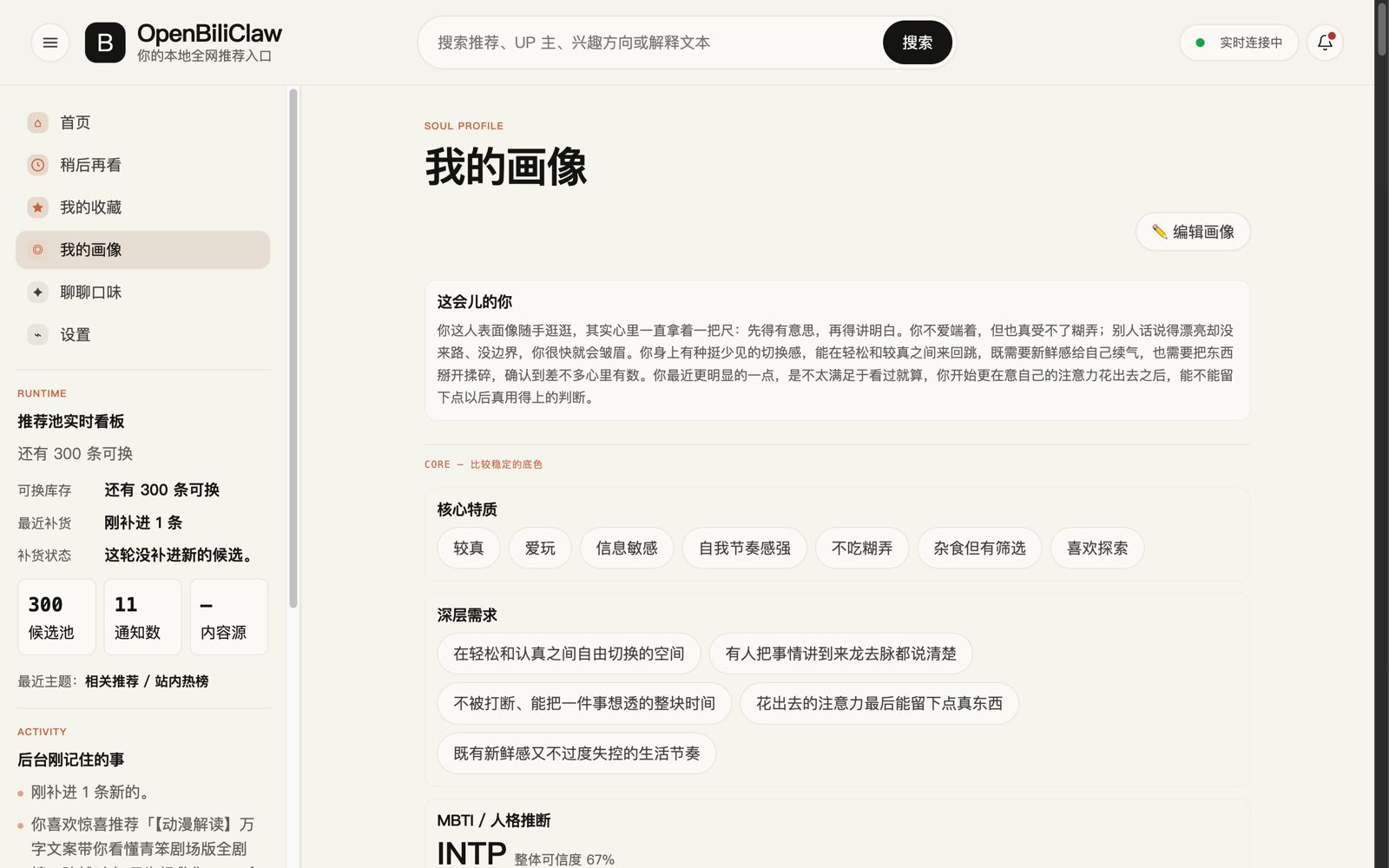
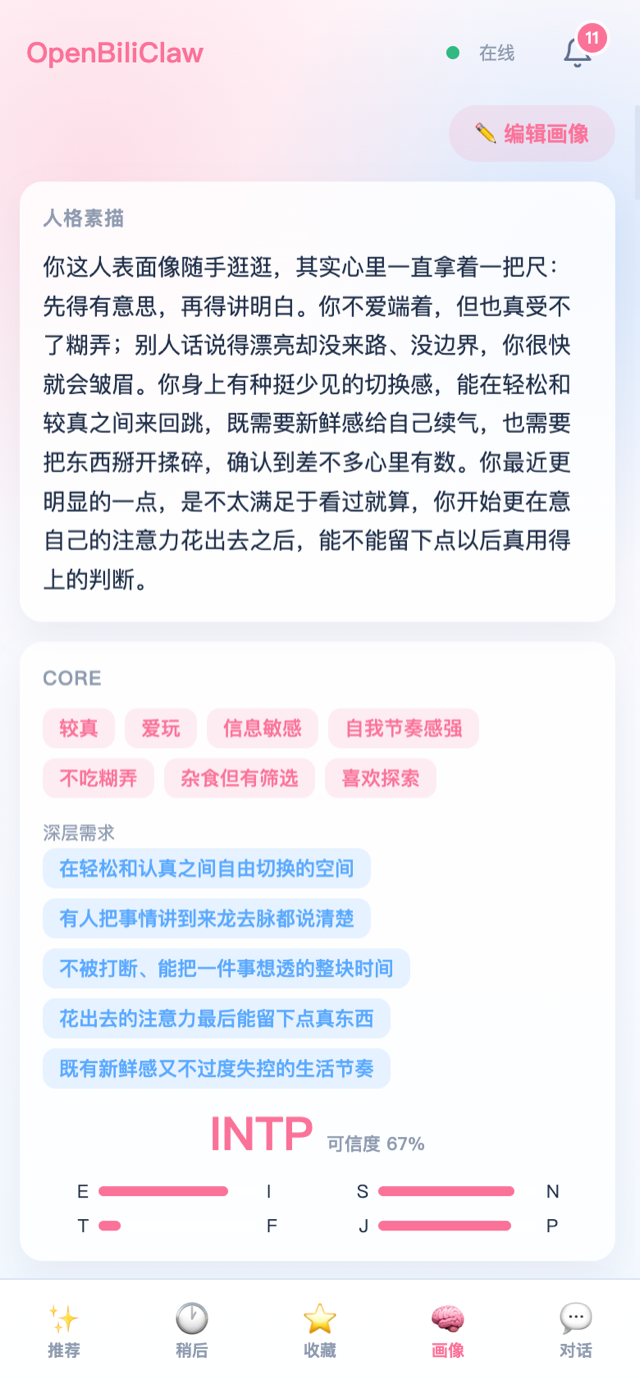
Instead of basic tag matching based on word overlap, the agent builds a five-level interest model (events, preferences, attention patterns, insights, and overall personality profile). The model attempts to determine your information perception style and even approximate MBTI type.
Key features that caught my attention
Attempting to guess hidden interests
Regular recommendation systems follow the well-worn path of collaborative filtering. If hundreds of people watched video B after video A, you'll be shown video B.
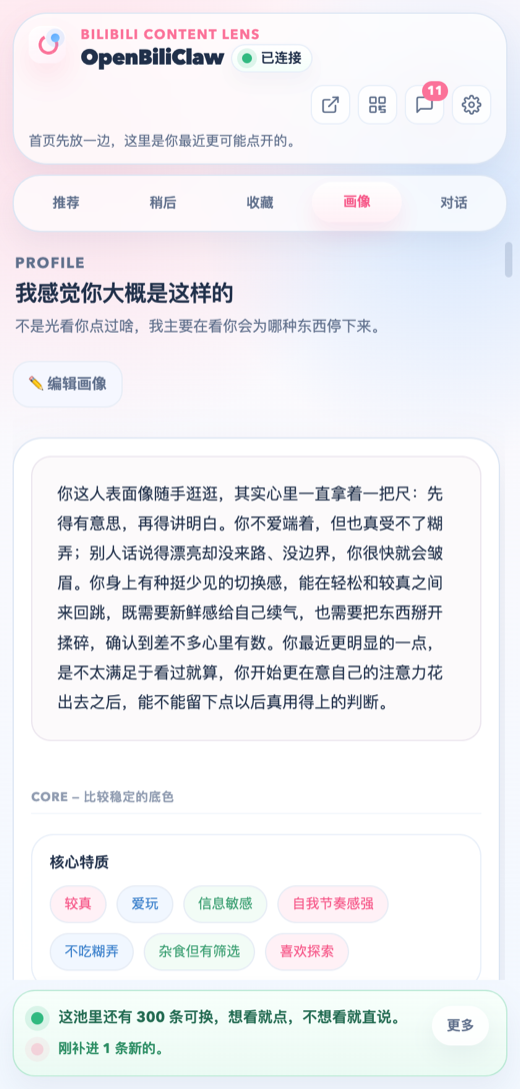
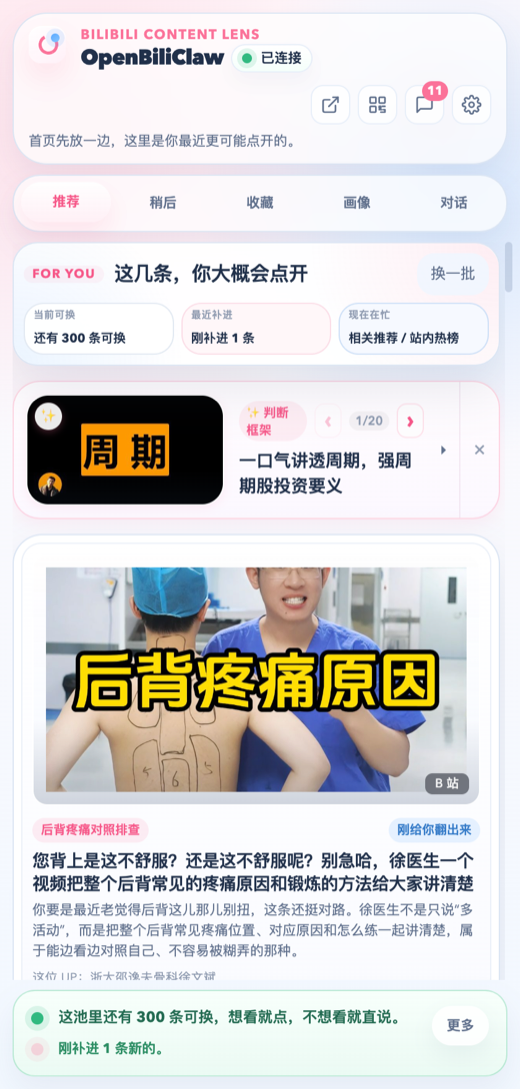
OpenBiliClaw works differently. The agent tries to build associative bridges. If you're studying how mechanical watches work, the system might suggest an interest in parametric architecture or industrial design. It mixes such discoveries into your feed with a hypothesis label. If you react positively, the topic gets locked into your profile. If not, the agent simply stops proposing it.
Human-readable recommendation explanations
For each content card, the agent generates a natural language explanation. Instead of the standard "you might like this" label, it writes a detailed comment like: "You were exploring macroeconomics last week, and in this video the author breaks down debt cycles using land auction examples."
Dialogue-based calibration
You can communicate with the agent through a built-in chat. If recommendations go off track, just write about it in text. The agent asks clarifying questions in Socratic style, figures out the details, and immediately rebuilds the scoring of candidates in the database.

Complete autonomy and privacy
The server-side doesn't require third-party cloud accounts from the project authors. All 30-day browsing history, bookmarks, and profiles are stored in a SQLite file. For reasoning, you can connect your own API key to OpenAI, Claude, DeepSeek, Gemini, or deploy a local LLM via Ollama.
How to deploy and try it out
For basic launch, developers offer ready-made binaries for macOS and Windows with embedded Ollama, as well as automated installation scripts.
If you're used to controlling everything through the terminal, the project can be spun up via uv or standard venv:
# Клонируем репозиторий
git clone https://github.com/whiteguo233/OpenBiliClaw.git
cd OpenBiliClaw

# Ставим зависимости через uv
uv sync

# Копируем и настраиваем конфиг
cp config.example.toml config.toml
vim config.toml
In the config.toml file, configure keys for LLM or addresses of local inference servers. Then run initialization and start the background service:
# Настройка локальных эмбеддингов
uv run openbiliclaw setup-embedding

# Первичный сбор данных и построение портрета
openbiliclaw init

# Запуск фонового демона и веб-интерфейса
openbiliclaw start
After startup, the web interface is available at http://127.0.0.1:8420/web. For mobile devices, there's an adaptive version at /m/, and the author is building a Flutter client in a separate repository.
For integration with external AI agents like OpenClaw, Hermes, or Cursor, the repository includes an Agent Bridge adapter. Another agent can query OpenBiliClaw via CLI or WebSocket and send you interesting articles directly to your work chat.

The bottom line
The project has a specific focus: a significant portion of Chinese sources (Bilibili, Xiaohongshu, Zhihu) probably won't interest a Russian-speaking developer unless you're learning the language or following the Asian market.
On the other hand, the architecture is open for expansion. Modules for Reddit, YouTube, and arbitrary web already work here. The idea of taking the recommendation algorithm out of corporations' hands onto your own machine and putting it under a local language model's control feels fresh and viable. If you're tired of junk in your feeds and want to experiment with personal agents, the project is definitely worth cloning and exploring.
Ähnliche Projekte