AI Data Science Team - When AI Agents Take Over the Routine in Data Science
A familiar situation: you just received a new dataset, and before you can get to the most interesting part — building models and extracting insights — you have to go through a long and sometimes monotonous path. Loading data, cleaning it from missing values and outliers, transforming formats, exploratory data analysis (EDA), visualization... The same thing every time. What if you had a whole team of assistants who could take over this routine, freeing up your time for strategic tasks?
This is exactly the kind of "team" offered by the AI Data Science Team project from Business Science. It's not just a library, but an entire ecosystem consisting of specialized AI agents and the flagship application AI Pipeline Studio. The essence of the project is to automate the lion's share of routine tasks in Data Science, turning them into reproducible and visually clear pipelines. If you're a data scientist, ML engineer, or analyst who wants to speed up your work and focus on high-level problems, this project definitely deserves your attention.
AI Pipeline Studio: Your Visual Control Center
The heart of the project is AI Pipeline Studio, an interactive web application based on Streamlit that turns the data analysis process into a visual and reproducible pipeline. Imagine that you're not just writing code, but assembling a logical chain of steps, each of which can be executed either manually or with the help of an AI agent.
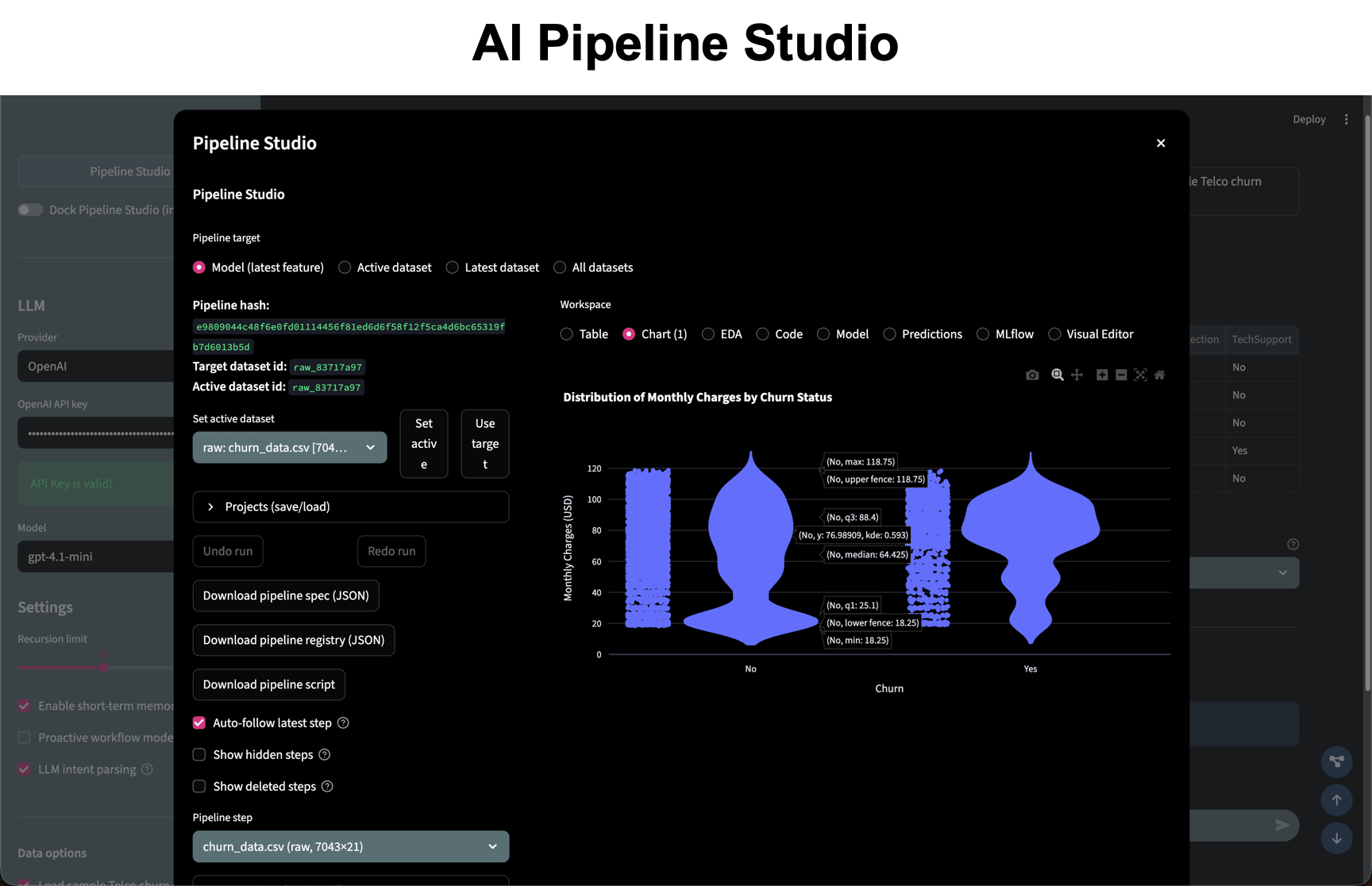
What is particularly valuable here?
- Visual editor: You see the entire process from data loading to predictions.
- Reproducibility: Each pipeline step generates a script, ensuring complete transparency and the ability to rerun.
- Working with multiple datasets: Easily combine and manage data from different sources.
- MLflow integration: Track experiments and manage models directly from the studio.
- Storage control: Manage the volume of stored data and "revive" old projects when needed.
Starting the studio is very simple:
streamlit run apps/ai-pipeline-studio-app/app.py
A Team of Smart Agents: From Data to Model in Seconds
Under the hood, the Studio runs a whole army of specialized AI agents. Each agent is tailored for a specific task in Data Science, making them incredibly effective.

Here are just a few of them:
- Data Loader Tools Agent: Will load data from various sources, perform initial inspection.
- Data Cleaning Agent & Data Wrangling Agent: Will clean data from missing values, outliers, transform types, prepare for analysis.
- Data Visualization Agent & EDA Tools Agent: Will build informative charts, perform exploratory analysis, help find dependencies.
- Feature Engineering Agent: Will create new features that can improve model quality.
- H2O ML Agent & MLflow Tools Agent: Will build and evaluate machine learning models, help with model lifecycle management.
- SQL Database Agent: Will allow you to interact with databases, extract and manipulate data.
- Supervisor Agent: Coordinates the work of other agents, ensuring cohesion of the entire process.
These agents can work both individually and as part of complex multi-agent workflows, such as "Pandas Data Analyst" or "SQL Data Analyst", which are already ready to use.
Flexibility in LLM Choice: OpenAI or Local Models
The project developers made sure that you are not tied to a single LLM provider. You can use both powerful OpenAI models (for example, gpt-4.1-mini) and local solutions such as Ollama. This is especially relevant for those who are concerned about data privacy or want to experiment with different models without high costs.
For OpenAI:
from langchain_openai import ChatOpenAI
llm = ChatOpenAI(
    model_name="gpt-4.1-mini",
)
For Ollama (first you need to run ollama serve and download a model, for example ollama pull llama3.1:8b):
from langchain_ollama import ChatOllama

llm = ChatOllama(
    model="llama3.1:8b",
)
Under the Hood: Python, Agents, and Streamlit
The project is built on Python 3.10+ and actively uses agent-oriented programming concepts. Although the README doesn't explicitly list all frameworks, it's safe to assume that something like LangChain or similar tooling for creating and managing LLM agents is at the core. The flagship AI Pipeline Studio application is implemented using Streamlit, which ensures rapid development of interactive web interfaces and allows you to easily run it locally.
The agent-based architecture allows creating modular and extensible systems. Each agent is essentially a specialized microservice that knows how to perform a specific set of tasks, using LLM for decision-making and coordinating actions. This provides enormous flexibility: you can create your own agents, extend the functionality of existing ones, or combine them into new workflows.
Where Will This Come in Handy? AI Data Science Team Use Cases
- Rapid prototyping and EDA: Need to quickly understand the structure of a new dataset, find anomalies, build basic visualizations? Launch the EDA agent, and it will do it for you, saving hours of manual work.
- ETL process automation: Data loading and cleaning agents can become the foundation for automated extract, transform, and load pipelines, especially for unstructured or semi-structured data sources.
- ML training and experiments: Use agents for automatic feature creation, model selection, and quality evaluation. MLflow integration makes it easy to track experiment results.
- Interactive data analysis: AI Pipeline Studio allows you not just to run scripts, but to interact with data in real time, make adjustments, and see results instantly. This is an ideal tool for exploratory analysis.
- Training and demonstrations: For beginners in Data Science or for demonstrating concepts to colleagues, visual pipelines and automated agents can be a great help for understanding the entire process.
Should You Try AI Data Science Team? Absolutely!
AI Data Science Team is an ambitious and very promising project that aims to rethink the approach to working with data. It offers a powerful set of tools for automating and accelerating routine tasks, allowing data scientists to focus on the more complex and creative aspects of their work.
Who will it especially suit?
- Data scientists and analysts who are tired of repetitive data cleaning and preparation tasks.
- ML engineers looking for ways to speed up prototyping and create reproducible ML pipelines.
- Teams that want to standardize and visualize their data analysis processes.
- Developers interested in agent systems and applying LLMs to real-world tasks.
The project is in beta version, which means possible changes, but even now it demonstrates enormous potential. If you want to be at the cutting edge of technology and significantly increase your productivity, be sure to check out the project's GitHub page and give it a star — it will take just a couple of seconds, but will really help the developers! And even better — try it out and share your impressions.
Proyectos relacionados