Kagent: Your New AI DevOps Engineer?
Imagine: it's 3 AM, something's gone wrong in production. As you rub your eyes and open your laptop, a report already arrives in Slack: "Detected a spike in 500 errors in service X. Checked logs of pod Y, looks like a database connection failure. Started rolling back to the previous stable version". Science fiction? Not quite anymore. Today we'll talk about a project that brings us closer to such a future — kagent.
I stumbled upon it while browsing CNCF projects, and it immediately caught my attention with its idea. In short, kagent is a framework that lets you create, deploy, and manage AI agents directly in Kubernetes using familiar approaches.

Why AI agents in Kubernetes?
Sound familiar? You have Grafana for metrics, Prometheus for alerts, Argo for deployments, Helm for managing charts, and a dozen other tools. They all work great, but to solve a complex problem, an engineer needs to switch between dozens of tabs, piecing together information bit by bit.
The idea behind kagent is to give an AI agent "hands" and "eyes" inside your cluster. Such an agent can't just receive notifications — it can independently interact with the tools you already use every day. It can:
- Query data from Prometheus.
- Check release status in Helm.
- View pod logs via
kubectl. - Analyze Istio configuration.
Essentially, you get not just a chatbot, but a full-fledged assistant that lives in the same environment as your applications and speaks the same language.
How it works under the hood?
The most elegant thing about kagent is its Kubernetes Native approach. You don't need to learn a new complex DSL or API. If you've worked with Kubernetes, you're already halfway to understanding kagent.
1. Agents as Custom Resources (CRD)
The key concept is declarative agent description. Simply put, you describe your AI agent in a YAML file just like you describe Deployment or Service.
apiVersion: kagent.kagent.dev/v1alpha1
kind: Agent
metadata:
  name: devops-assistant
spec:
  # Какую LLM использовать
  modelConfig:
    name: openai-provider
  # Какие инструменты дать в руки агенту
  tools:
  - name: kubernetes-tools
  - name: prometheus-tools
  # Системный промпт, определяющий его роль
  systemPrompt: |
    You are a senior DevOps engineer. Your goal is to
    autonomously monitor and troubleshoot issues in the cluster.
    Use the provided tools to investigate and report your findings.
This is brilliant! The entire agent configuration — its personality, tools, model — is stored in Git and applied via kubectl apply. GitOps for AI agents, as it should be.
2. Flexibility in choosing "brains" (LLM)
Kagent doesn't lock you into a single provider. Want to use OpenAI? Sure. Prefer Anthropic or Google Vertex AI? No problem. Or maybe you want to run a local model via Ollama to keep data in-house? That's supported too. All providers are configured via their own CRD ModelConfig.
3. Tools for every occasion
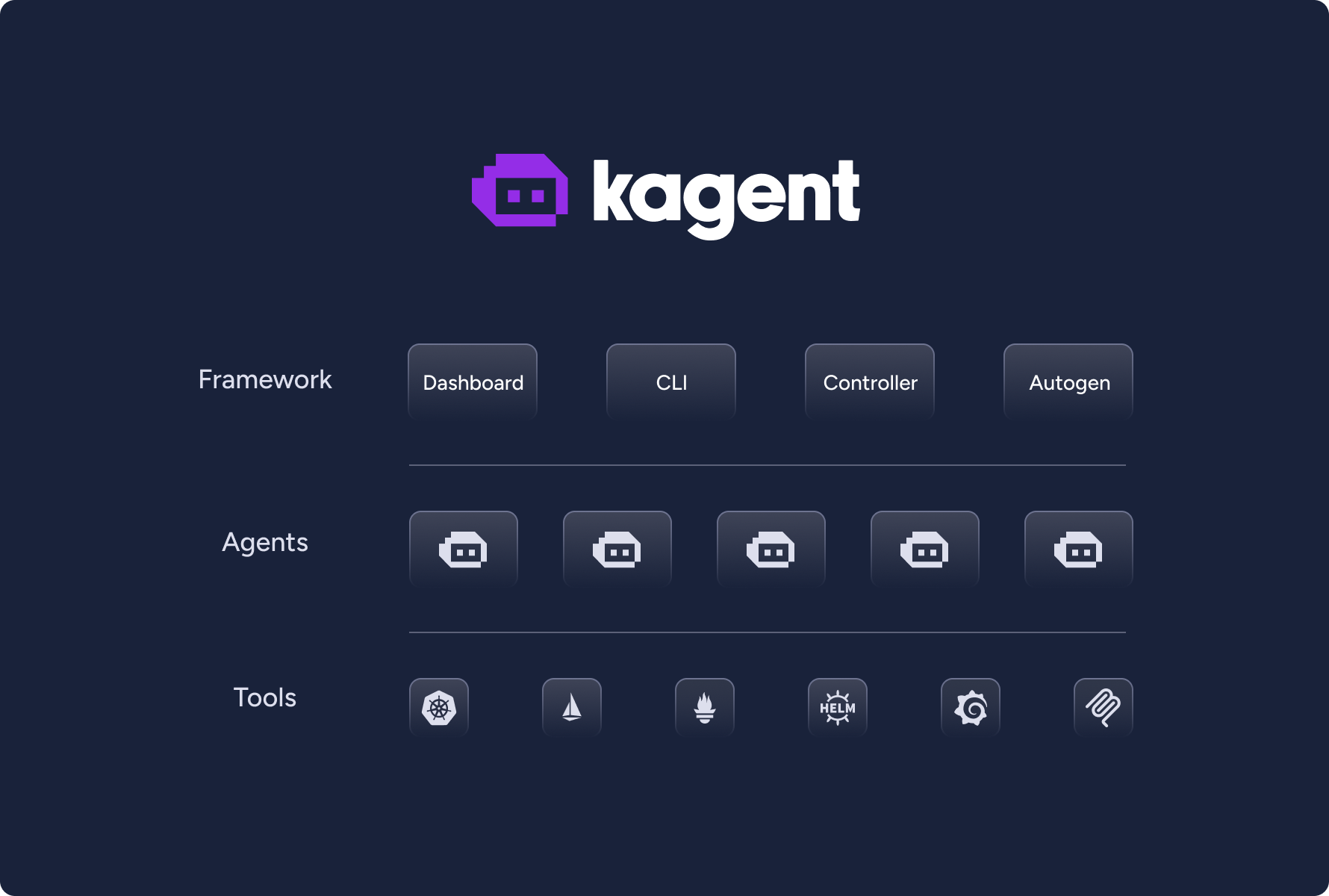
An agent without tools is useless. Kagent comes with a ready-made set of "wrenches and screwdrivers" for working with popular Cloud Native tools:
- Kubernetes
- Istio
- Helm
- Argo
- Prometheus
- Grafana
- Cilium
And importantly, this list is extensible. You can add your own tools if you have company-specific utilities.
Architecture: simple and clear
The project consists of four main components, making the architecture transparent:
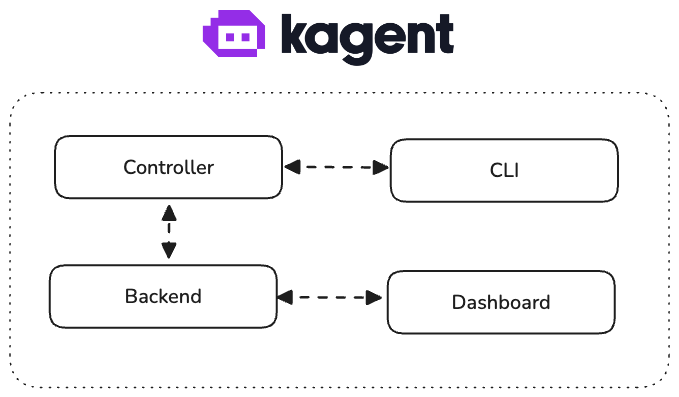
- Controller: This is the brain of operations. A Kubernetes controller that monitors
Agent,ModelConfig, and other resources, and spins up everything needed for them to work. - Engine: The engine that directly executes agent logic.
- UI: A web interface for convenient management and monitoring of agents.
- CLI: A command-line utility for those who prefer the terminal.
Plus, kagent supports OpenTelemetry, so you can track exactly what your agent is doing, which commands it's executing, and what decisions it's making. For an AI world that's often perceived as a "black box", this is a huge plus.
Practical scenarios: where can it be useful?
Let's imagine how kagent could make a developer or SRE's life easier.
- Smart alert triage: An agent receives an alert from Prometheus about high CPU load. It immediately goes and checks
kubectl top pods, finds the most "hungry" pod, looks at recent commits in Git related to this service, and sends a report to Slack: "Load on service X increased after merging commitabc1234. You might want to look at the new caching function". - Interactive helper for newcomers: A new team member can ask the agent in chat: "Show me all services in
billingnamespace" or "What's the status of the latest deployment inproduction?". The agent executes the necessary commands and gives an answer in human language. - Automation of routine tasks: You can create an agent that periodically checks TLS certificate expiration dates in the cluster and warns in advance about the need to renew them.
Is it worth trying?
kagent is a young but very promising project in active development. It clearly demonstrates how AI technologies can be organically integrated into the existing Kubernetes ecosystem.
Who should pay special attention:
- DevOps/SRE engineers who want to automate routine tasks and speed up incident resolution.
- Platform teams that build internal tools for developers.
- Everyone interested in practical LLM applications not for writing poetry, but for solving real infrastructure problems.
The project hasn't reached version 1.0 yet, so using it at the heart of production might be premature. But for internal tools, automation, and experiments — it's a real find.
Check out their GitHub, give it a star, and try deploying your first agent via the Quick Start. I think the future of DevOps belongs to tools like this.
Related projects