Penetration Testing Cheat Sheet as an Interactive Map
Has this ever happened to you: you're sitting in front of a terminal, nmap has shown a bunch of open ports, but your mind goes blank? You know the theory, you've read writeups, but in the moment it's hard to figure out what to tackle first. Do you need to check SMB, poke around a web form, or immediately search for known CVEs for an outdated Apache version?
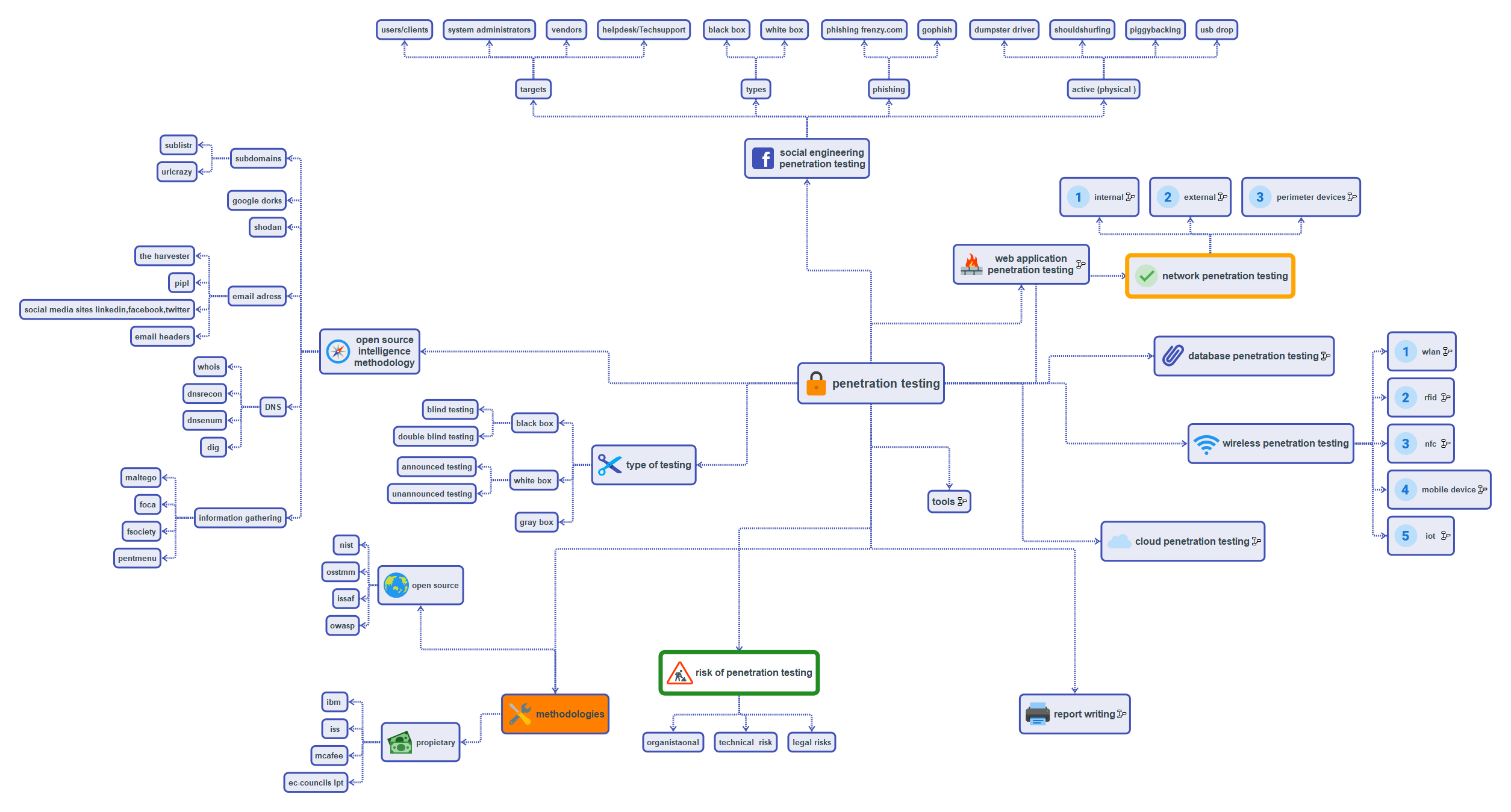
In situations like these, it's not bulky textbooks that save you, but simple visual diagrams. The pentestmindmap repository solves exactly this problem. The author compiled basic penetration testing steps, preparation for certifications like OSCP or CEH, and packed everything into an interactive graph.
What's Inside the Project
Essentially, we're looking at a web page with a structured tree of penetration testing scenarios. The project lives right on GitHub Pages, so there's no need to clone the repository or set up a local environment, although you can grab the static files for offline use if you want.
The project's README is extremely concise—the author didn't write kilometers of text. The whole point is embedded in the interactive map itself, which breaks down the audit process into logical branches:
- Information gathering and reconnaissance (OSINT, port scanning, subdomain enumeration)
- Vulnerability and service analysis (web applications, databases, network services)
- Exploitation and initial access
- Privilege escalation on Linux and Windows systems
The map helps you stay on track during an investigation. When you're scanning a host, it's easy to get stuck on one dead-end branch and forget to check trivial things like anonymous FTP login or default credentials on an admin panel.
How the Technical Part Works
There's no complex frameworks, backend, or heavy bundles here. The repository consists of basic HTML, CSS, and JavaScript.
Lightweight tree visualization libraries are used for rendering the graph. Nodes can be collapsed and expanded with a mouse click so you don't overwhelm the screen with extra information. If you want to deploy a local copy without internet access, just grab the repository via git:
git clone https://github.com/5bhuv4n35h/pentestmindmap.git
cd pentestmindmap
# открываем index.html в любом браузере
open index.html
Such simplicity is refreshing. The files weigh a couple of megabytes, and nothing will break from updating Node.js versions or changing npm dependencies.
Where This Map Really Comes in Handy
Penetration testing consists of slightly more than fully routine work. The map covers several clear tasks:
- Certification prep. If you're preparing for OSCP, eJPT, or CEH, you need a clear methodology in your head. Exam proctors love catching students being careless when they miss an obvious vector due to rushing. The step tree works as a safety net.
- CTF competition checklist. Time is limited during competitions. When the team hits a dead end on a tough task, a diagram open in front of them helps quickly scan for non-standard options.
- Training juniors. Newcomers to information security struggle to keep all the tools in memory. The map visually links a specific service (for example, RPC or SNMP) to a sequence of actions for testing it.
Of course, the project won't replace hands-on practice on platforms like Hack The Box or TryHackMe. It's just a handy reference guide, neatly organized.
Pros and Limitations
The main advantage is clarity. Instead of twenty open tabs with cheat sheets for different ports, you have a single canvas.
The project has its drawbacks too. The author hasn't updated the deeper branches in a long time, so some modern techniques for working with Active Directory or cloud infrastructure (AWS, Azure) aren't covered in detail. If you need specialized attacks on modern frameworks, you'll have to extend the map yourself. Fortunately, the code is open, and adding your own nodes to the JSON or markup structure is straightforward.
Is It Worth Looking At
If you do ethical hacking, manage infrastructure, or just want to understand how attackers probe network perimeters—add the project's interactive page to your bookmarks.
It won't turn you into a guru overnight, but it will definitely come in handy when you get stuck during the reconnaissance phase and are painfully trying to remember what else you can squeeze out of an open port 445. Open the map, scan the branches, find the step you missed, and get back to testing.
Related projects