DIY Solar Concentrator — When a Hobby Project Outperforms Industrial Counterparts
Imagine a device that collects sunlight 48 times more efficiently than a standard panel, costs pennies to build, and can heat an oven to 210°C in half an hour. Sound like science fiction? However, French engineer Rémi Peuchot created exactly such a project — an open-source solar concentrator from improvised materials.
Why It's Better Than Solar Panels
Unlike photovoltaic panels with their 15-20% efficiency, this concentrator uses the principle of light focusing:
- 48 ordinary mirrors (the kind hung in bathrooms) direct reflections to a single point
- Automatic ESP32 system tracks the sun with pixel-level precision
- Specific implementation — an oven where temperature reaches 210°C
The key advantage? 1,000 W of thermal power while consuming only 3.8 W of electricity — it's like charging your smartphone to heat an entire house.
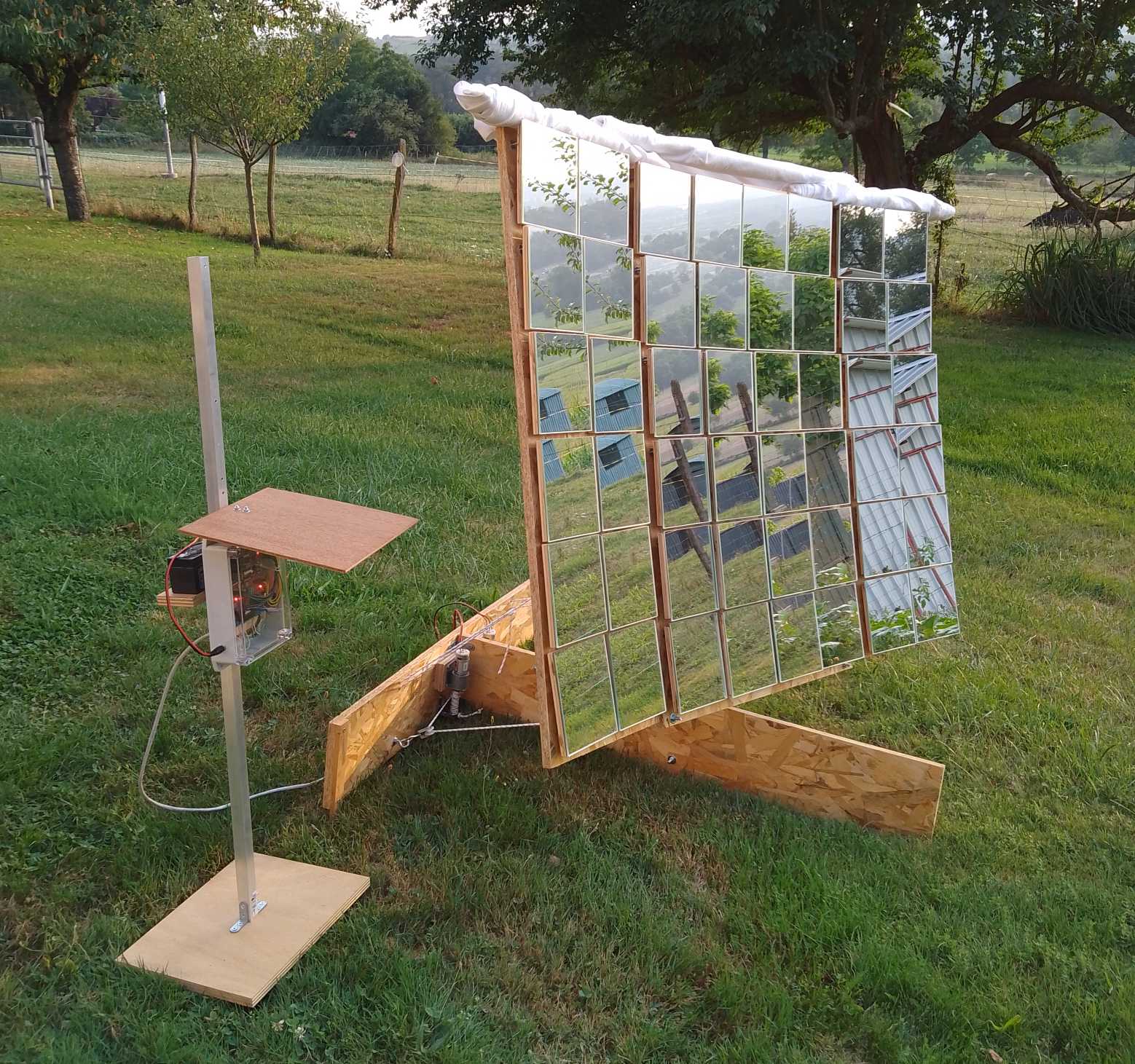
Technical Highlights of the Project
-
Budget Components
- Mirrors from a hardware store (15×15 cm)
- Motors from Gotronic models
- Glass from an IKEA shelf used as the oven
-
Smart Automation
- ESP32-CAM analyzes the position of the sun spot
- Algorithm adjusts mirror positions 24/7
- Web interface for monitoring
-
Modular Design
- 3D models of all parts available publicly
- Electronic schematics with calculations
- Software under GNU GPL v3
⚠️ Important: the project requires caution! The focal point can cause burns or fire. The author strongly recommends constant supervision.
Where Can This Be Applied?
The current version is a proof of concept, but the potential is enormous:
- Cooking: sterilizing canned goods, baking
- Energy: heating water for heating systems
- Emergency situations: desalination of water without electricity
- DIY manufacturing: melting plastic, glass
The author is already working on scaling up — the next goal is several kilowatts of power.
Is It Worth Trying?
The project is ideal for:
- Experimental engineers
- Alternative energy enthusiasts
- Physics teachers
- Survivalists and cottage owners
If you were looking for a project at the intersection of mechanics, electronics, and programming — this is an excellent candidate. Just don't forget about safety: 48 suns in one point tolerate no jokes.
Related projects