Paperclip Turns Chaos from Dozens of AI Agents into a Managed Company
Sound familiar? You've got a dozen tabs open in the terminal with Claude Code, Cursor running alongside, and an autonomous script lurking somewhere in the background. At some point, it becomes unclear which bot is working on what, where the relevant context lives, and how much money has already gone toward tokens. Reboot your computer — and the whole fragile setup collapses.
The creators of Paperclip approached this problem from a different angle. While a standalone AI agent like OpenClaw or Claude functions as a simple executor, Paperclip assumes the role of a company. The project provides a complete management system: organizational structure, task tracking, strict budget limits, and an auditable decision log.
Why Change the Conventional Approach to Autonomous Agents
Typically, working with AI tools means exchanging messages in a chat or running CLI utilities. With a single agent, everything stays manageable. The real challenges emerge when trying to assemble them into an autonomous team.
Here are the problems you encounter in practice:
- Context loss. An agent sees a task locally but loses connection to the overall project goal.
- Uncontrolled costs. A looping bot can burn through a month's worth of token limits in an hour.
- Lack of coordination. Two agents start editing the same file or duplicate work.
- Resumption difficulties. Restarting the terminal wipes out the session history.
Paperclip changes the interaction logic. Instead of directly managing each script, you define a global goal, create a role structure, and assign suitable engines to these positions.
Four Pillars of Orchestration
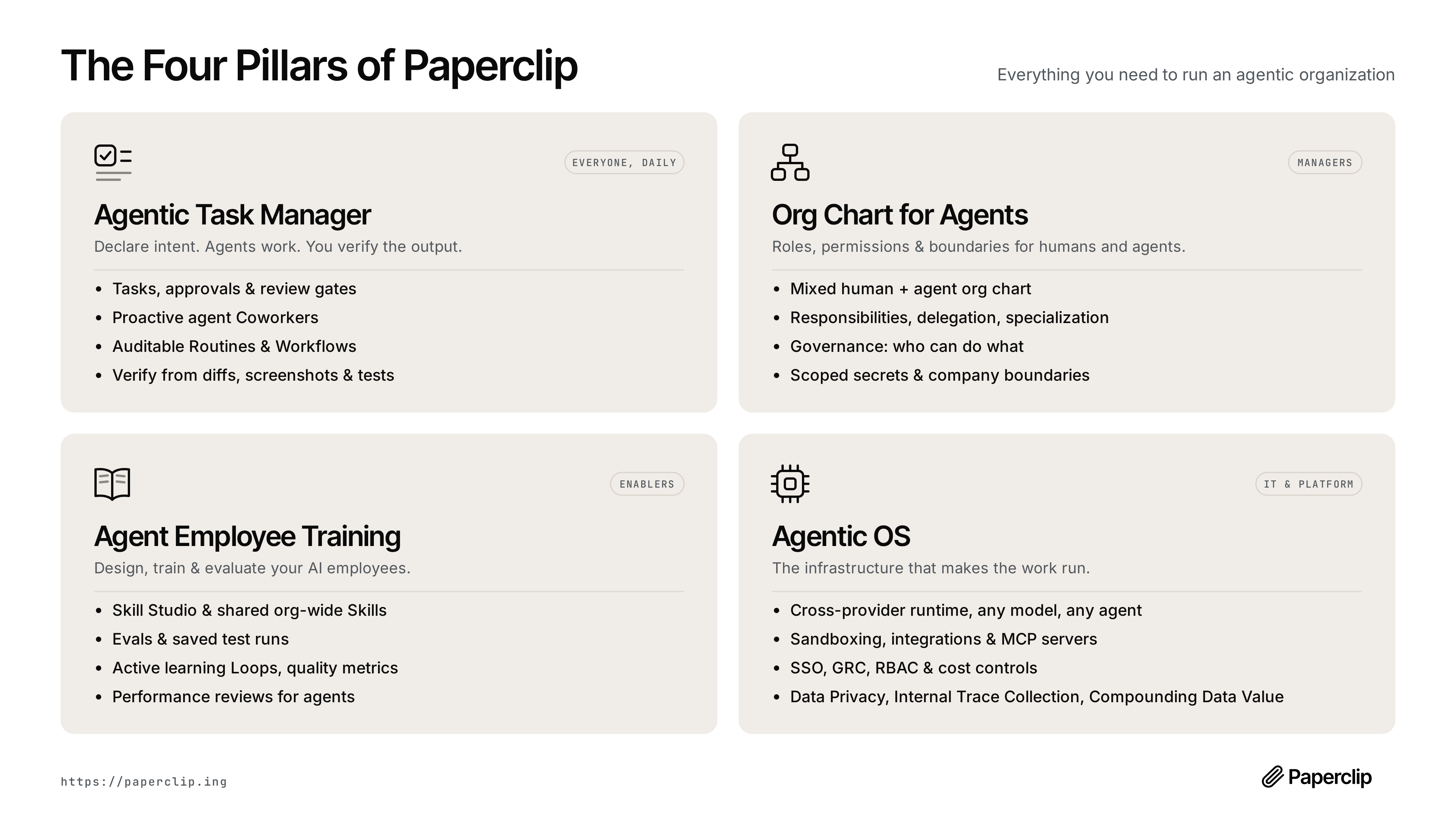
The authors built four areas into the architecture, without which collective bot work devolves into chaos.
Task Tracker for Agents
Each task is formatted as a ticket. The agent receives a clear description, links to parent goals, and connections to other tasks. Changes are saved as diffs, screenshots, or test results. A human approves the results before the task moves forward.
Organizational Structure and Areas of Responsibility
In Paperclip, you can define role hierarchies, distribute secret access, and delegate tasks from the top down. If a manager bot breaks a feature into subtasks, it automatically distributes them to subordinate agents.
Training and Skill Development
The platform includes Skill Studio for creating shared team capabilities. This is also where automated tests run, quality metrics are checked, and agent work is reviewed.
Execution Layer
The server supports various environments and models. You can simultaneously connect Claude Code, Codex, Cursor, regular bash scripts, or webhooks. The system isolates executions, monitors budgets, and collects traces.
Under the Hood
Paperclip is built with Node.js and a React-based graphical interface. The server functions as an independent control panel, with data persisted in an embedded PostgreSQL database.
┌──────────────────────────────────────────────────────────────┐
│                       PAPERCLIP SERVER                       │
│                                                              │
│  ┌───────────┐  ┌───────────┐  ┌───────────┐  ┌───────────┐  │
│  │Identity & │  │  Work &   │  │ Heartbeat │  │Governance │  │
│  │  Access   │  │   Tasks   │  │ Execution │  │& Approvals│  │
│  └───────────┘  └───────────┘  └───────────┘  └───────────┘  │
│                                                              │
│  ┌───────────┐  ┌───────────┐  ┌───────────┐  ┌───────────┐  │
│  │ Org Chart │  │Workspaces │  │  Plugins  │  │  Budget   │  │
│  │ & Agents  │  │ & Runtime │  │           │  │ & Costs   │  │
│  └───────────┘  └───────────┘  └───────────┘  └───────────┘  │
└──────────────────────────────────────────────────────────────┘
         ▲              ▲              ▲              ▲
   ┌─────┴─────┐  ┌─────┴─────┐  ┌─────┴─────┐  ┌─────┴─────┐
   │  Claude   │  │   Codex   │  │   CLI     │  │ HTTP/web  │
   │   Code    │  │           │  │  agents   │  │   bots    │
   └───────────┘  └───────────┘  └───────────┘  └───────────┘
The primary interaction mechanism relies on regular polling through heartbeats. Agents don't need to stay resident in memory. The server wakes a bot on schedule or by event, delivers the current task context, and records the outcome.
If a bot exceeds its spending limit, the system halts its operation and cancels pending queues. This prevents unexpected API bills.
How to Deploy the Project Quickly
You can launch the system with just a couple of commands. For a quick overview without a permanent installation, the npx utility works well:
npx --registry https://registry.npmjs.org paperclipai onboard --yes
If you prefer to clone the repository and build from source manually:
git clone https://github.com/paperclipai/paperclip.git
cd paperclip
pnpm install
pnpm dev
The command will start the API server on port 3100 and automatically deploy the embedded PostgreSQL. No external database configuration is necessary. The only prerequisites are Node.js version 20 or higher and pnpm 9.15+.
Who Will Find This Tool Useful
Paperclip is useful for developers and founders who are trying to automate routine processes using neural networks. If you have a single bot for writing code, adding complexity to your stack doesn't make sense. But when bots multiply and tasks go beyond writing functions, Paperclip takes over the routine work of tying the entire system together.
The project is released under the MIT license and has gathered over 75 thousand stars on GitHub, which speaks to the high interest in autonomous multi-agent systems.
Progetti correlati