How the legendary Google Sky Map survived on pure enthusiasm

Remember the presentations of the first Android phones around 2008–2009? Back then, Google was proudly showcasing built-in motion sensors and a compass. The main showstopper at Searchology 2009 was the Google Sky Map app. You raised a heavy HTC Dream to the night sky, swiveled it around, and constellations and planets appeared on the small screen in real time. It felt like the future had already arrived.
Then corporate priorities shifted. In 2011, Google discontinued active support, but the developers wouldn't let the project die. They begged for permission to open-source the code, broke away from the Google brand, and kept the project on their own shoulders. The stardroid repository on GitHub still lives under the name Sky Map, and behind it stands an amazing story of engineering perseverance.
Why the repository is called stardroid
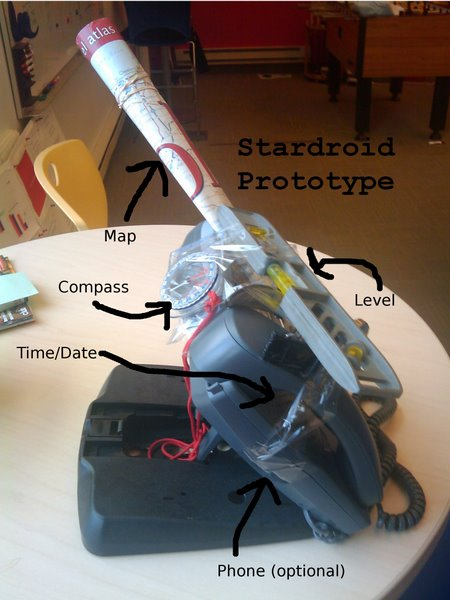
Inside Google, the project had the codename Stardroid. The company's lawyers were afraid of copyright claims from Star Wars, so for the release they chose the boring and straightforward Sky Map. Inside the codebase, the name stardroid remained the main package identifier.
After spinning off, the project adopted GPLv3 licensing (though some legacy code retained Apache 2.0). The developers made a deliberate choice to keep the app completely free—no trackers, in-app purchases, or advertising. This stands out as a genuinely honest open-source astronomy tool for mobile platforms.
Here's what the app prototype looked like in its early days:
What the app can do today
Sky Map turns your phone into an interactive viewfinder for space observation. The core concept remains unchanged, but the authors have polished the math and algorithms over the years.
- Sensor-based positioning. The app collects raw data from the accelerometer, gyroscope, and magnetic compass to calculate the user's gaze vector on the celestial sphere.
- Celestial object catalog. The database includes coordinates of bright stars, Solar System planets, constellations, and Messier objects.
- Search with pointer. If you want to find Mars or the Andromeda galaxy, you type the name into search, and the app shows arrows on screen pointing exactly where to turn your hands.
- Time travel mode. You can see what the sky looked like on your birthday or where Jupiter will be in six months.
What's interesting under the hood for developers
If you open the project now, you'll see a mix of Kotlin and legacy Java code. The repository has plenty of interesting things for anyone interested in mobile development and applied mathematics.
Working with sensors without sugarcoating
The main pain point for any astronomy app on smartphones is compass calibration and noisy sensors. Earth's magnetic field gets distorted by cases, cables, and metal objects in pockets. The Sky Map codebase implements sensor reading filtering so the image doesn't jitter from the slightest hand tremor, yet still responds instantly to device rotations.
The repository even has separate documents help.md and troubleshooting.md where the authors explain in detail why the built-in compass calibration in Android often doesn't work at all like programmers expect.
Rendering and trigonometry
All drawing is tied to spherical coordinates, right ascension, and declination. The app projects the 3D celestial sphere onto the flat smartphone screen accounting for current latitude, longitude, and GPS time. This is a great reference for anyone who wants to understand how to write custom rendering without heavy game engines like Unity.
On the threshold of version two
Right now the authors have closed pull requests to the main branch. The architecture of version one, laid down back in the Android 1.6 Donut era, has finally become obsolete. A team of ex-Googlers from Pittsburgh is right now completely rewriting the app from scratch as part of version V2, migrating it to a modern stack.
At the same time, the developers are fiercely protecting the project from unscrupulous clones. Graphics, logos, and visual assets are protected by copyright of Penterakt LLC. This was done specifically so that opportunistic dealers couldn't simply rebuild the project, stuff it with banners, and upload it to Google Play under someone else's name.
Who should study the project
Digging into the Sky Map code is worth it in two cases.
First, if you're building a mobile app with augmented reality, compass, or gyroscope and want to see how professionals smooth out sensor readings in real combat conditions.
Second, if you simply need a clean, lightweight astronomy atlas on your phone that doesn't ask for registration, doesn't show ads, and weighs just a few megabytes. You can find the app on Google Play as well as in the F-Droid repository.
Related projects