"cross": Pain-free Rust Cross-Compilation, Right Out of the Box
Are you familiar with the situation where you need to build a Rust project for some exotic architecture? For example, for an ARM board, an embedded system, or even for a different Linux distribution? Often this turns into a real quest: installing specific toolchains, configuring the environment, fighting with linkers and dependencies. Hours, or even days, go by trying to get everything working. And what if you need not just to build, but also to test the code on the target platform?
This is where cross comes to the stage — a project that promises "Zero setup" cross-compilation and cross-testing of Rust crates. Sounds like magic, doesn't it? Essentially, cross handles all the routine work associated with preparing the environment for cross-compilation, using Docker or Podman containers. Let's explore how this utility can significantly simplify a Rust developer's life.
What is cross and who needs it?
cross is a wrapper around cargo, the standard Rust package manager and build system. But instead of using your local toolchain, cross runs the build or test process inside a specially prepared container. Imagine a virtual machine, but much lighter and specialized for the specific task of cross-compilation. Inside this container, everything you need is already there: cross-toolchain, libraries, and all the components required for building for the target architecture.
Who will find this useful? Pretty much any Rust developer who needs to:
- Develop for embedded systems: ARM microcontrollers, Raspberry Pi, other single-board computers.
- Mobile development: Building components for Android.
- Create server applications for various Linux distributions or architectures (e.g., AArch64 on cloud servers).
- Develop cross-platform utilities that should work on Windows, Linux, various BSD systems.
- Automate CI/CD: So that tests and builds run equally reliably on any build machine.
Main advantages of cross: Magic in action
cross stands out with several key capabilities that make it a truly valuable tool:
1. "Zero setup" — no more environment struggles
This is probably the biggest "feature" of cross. Forget about manually installing gcc-arm-none-eabi, configuring linker scripts, or searching for the right versions of libc. cross will take care of everything needed inside the container. You just need to have Docker or Podman installed, and of course rustup for managing Rust toolchains. After that, you simply specify the target architecture, and cross does the rest.
2. Cross-testing: Not just building, but also verifying!
Building code for a different architecture is only half the battle. It's much harder to make sure it actually works. cross can not only compile but also run tests for target platforms, using QEMU emulation. This is an incredibly powerful capability that lets you catch bugs early, without waiting to deploy on real hardware.
Imagine: you write code for AArch64, but run tests on your x86_64 laptop. cross makes this a reality. Of course, QEMU has its limitations (for example, multi-threaded tests may run slowly or incorrectly), but for most unit tests, it's a lifesaver.
3. Widest support for target platforms
Take a look at the project's README — the list of supported targets is simply amazing! From Android to various Linux versions on ARM, MIPS, PowerPC, RISC-V, S390x, Sparc, and of course Windows and FreeBSD. There's even WASM support via Emscripten. This means cross can become your universal tool for the most diverse projects.
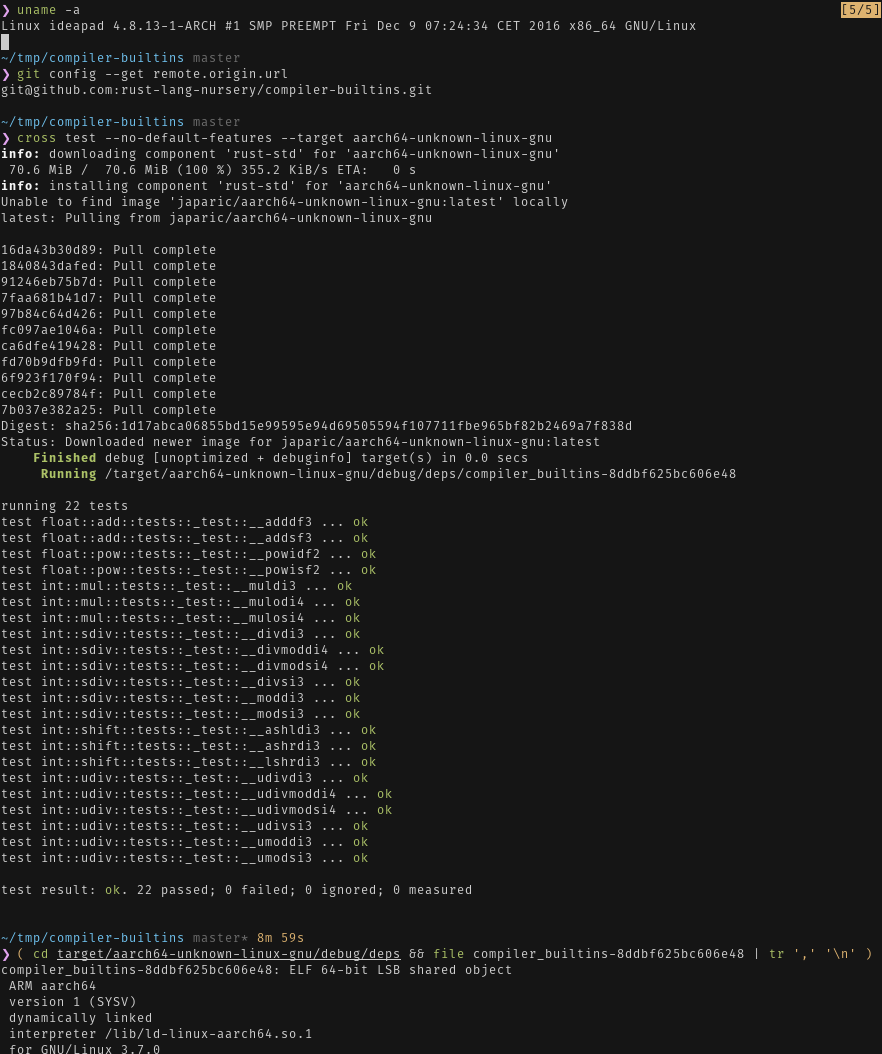 Example of
 cross test running for the aarch64-unknown-linux-gnu architecture
How it works under the hood: a bit of container and emulation magic
The core principle of cross is using containers. When you invoke cross build --target <target-triple>, cross searches for or downloads a predefined Docker (or Podman) image for that target architecture. Inside this image, everything is already configured: compilers, linkers, libraries. Your code is mounted into this container, and cargo runs inside it.
For cross-testing, cross uses QEMU and the Linux kernel's binfmt_misc functionality. binfmt_misc allows the kernel to run executables for other architectures, automatically proxying them through QEMU. This way, when cross test runs a binary compiled for ARM, the kernel "understands" that this is not a native executable and passes it to QEMU for emulation.
This elegant solution isolates all cross-compilation dependencies from your main system, keeping it clean and stable.
Getting started with cross: easier than it seems
Installing cross is extremely simple if you already have rustup and one of the container engines (Docker or Podman):
cargo install cross --git https://github.com/cross-rs/cross
Or you can download pre-built binaries from GitHub Releases. After installation, using cross is almost identical to using cargo:
# Сборка проекта для ARM64 Linux
cross build --target aarch64-unknown-linux-gnu

# Запуск тестов для MIPS64 Linux
cross test --target mips64-unknown-linux-gnuabi64

# Компиляция с дополнительными флагами Rustc
cross rustc --target powerpc-unknown-linux-gnu --release -- -C lto
As you can see, you just need to add cross before the build, test, or run command, specify the target platform, and voila — your Rust program compiles and even tests for a completely different architecture!
Flexible configuration for your needs
cross also offers extensive customization capabilities. You can configure build behavior, container images, environment variables, and much more. The configuration can be stored in Cargo.toml (in the [workspace.metadata.cross] section), in a separate Cross.toml file at the project root, or even passed through environment variables. This gives developers maximum flexibility to adapt cross to specific project requirements. For example, you can add additional system dependencies to the image or specify your own Docker image.
Who will especially benefit from cross?
- Embedded systems developers: If you write firmware in Rust for microcontrollers or single-board computers,
crosswill save you a lot of time on environment setup. - Teams working on cross-platform libraries or applications: Making sure your code works correctly on all supported platforms will become much easier.
- CI/CD engineers: Integrating
crossinto your pipeline will allow you to automate building and testing for many targets, ensuring more reliable releases. - Those experimenting with new architectures: Want to try Rust on RISC-V or PowerPC?
crosswill provide a ready environment without needing to set up VMs and manually configure compilers.
Conclusions: Is cross worth trying?
Absolutely yes! If you've ever experienced the pain of cross-compilation in Rust, cross will be a real discovery for you. It's not just a utility, it's a philosophy of "working out of the box" that lets you focus on writing code rather than fighting with tooling. The ease of use, powerful cross-testing capabilities, and wide platform support make it an indispensable tool in any serious Rust developer's arsenal.
So, if you haven't tried cross yet, maybe it's time to give it a chance and forget about most cross-compilation problems forever. Install it, try it, and most likely, it will stay with you for a long time!
Projetos relacionados