Neural Photo Editor: When Neural Networks Become Your Photo Editor
Magic in a Few Clicks
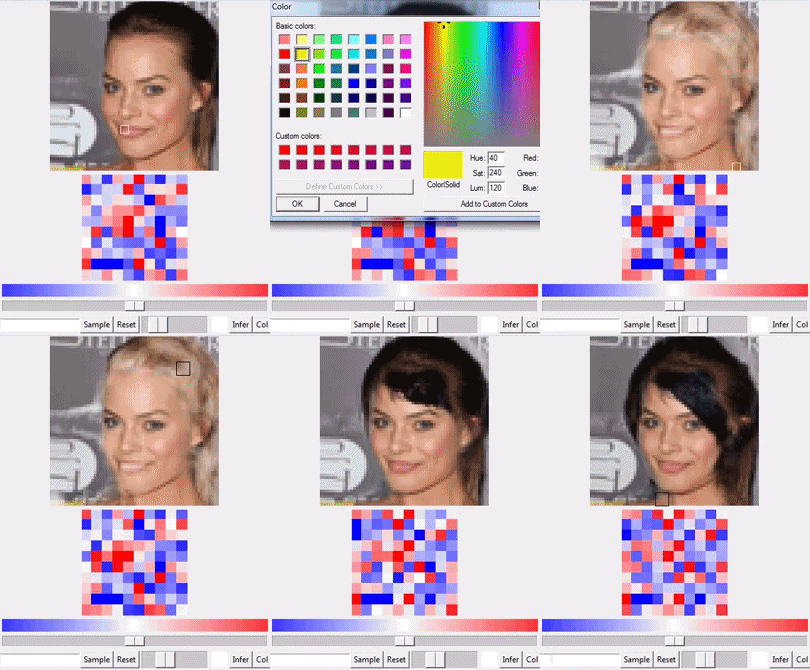
Imagine: you're painting on a photo, and the neural network doesn't just fill in the area—it generates a plausible continuation of the image. This isn't science fiction—this is exactly how Neural Photo Editor (NPE) works, a project by researcher Andrew Brock.
Who Is This For?
NPE isn't just another photo editor. It will be especially useful for:
- Graphic designers who want to quickly experiment with imagery
- Researchers in computer vision and generative models
- Anyone interested in practical applications of GANs (generative adversarial networks)
Key Features
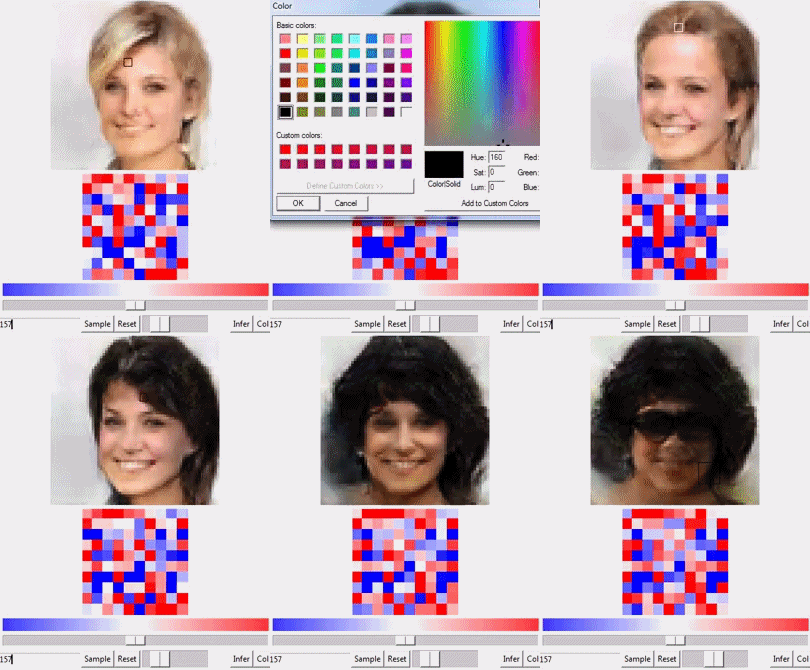
- Latent space editing — modifying images by manipulating the neural network's internal representations
- Interactive interface — a simple GUI with brushes, sliders, and buttons
- Real photo support — comes with the celebA dataset of 1,000 images for experimentation
- New image generation — the "Sample" function creates entirely new faces from random noise
How Does It Work Technically?
The project is built on:
- Theano (main framework)
- Lasagne (high-level wrapper)
- IAN (Introspective Adversarial Networks) architecture
Interestingly, even on weak GPUs (for example, GT730M with 1GB of memory) the editor runs without lag in simplified mode.
Practical Applications
Here are several scenarios where NPE can be useful:
- Quick prototyping of changes in portrait photography
- Exploring how GANs "understand" images
- Creating educational materials on generative models
- Artistic experiments with photos
How to Get Started?
Installation is fairly straightforward (but requires Python 2.7):
pip install Theano lasagne
python NPE.py
Full instructions are available in the project repository.
Verdict: Is It Worth Trying?
Neural Photo Editor is an excellent way to get hands-on experience with generative neural networks. While the project isn't brand new (2016), it clearly demonstrates key principles that remain relevant in computer vision today.
I especially recommend it for:
- Researchers who want to understand how GANs work "from the inside"
- Practitioners who need an unconventional tool for artistic editing
- Anyone interested in the history of generative model development
Give it a try—perhaps this project will inspire you to conduct your own experiments with neural networks!
Related projects